|
|
Title of invention (designation in Request for Grant suffices)
 |
|
The present invention relates to the field of long alimentary pasta, in particular of the spaghetti type, and more particularly still to an alimentary pasta of the type mentioned above which, although retaining all the typical organoleptic aspects of similar commercial products, is characterised by surprisingly rapid cooking due to the formation of specific longitudinal grooves, extending the whole of its length.
|
R. 27(1)(a)
Technical field to which invention relates
|
|
Various types of spaghetti with longitudinal grooves are already known from the state of the art which allow the cooking process to be effected in less time than that necessary for the same process using similar hollow cylindrical products (bucatini) or solid products. However, said products are not entirely without disadvantages, regarding above all the homogeneity of cooking.
|
R. 27(1)(b)
Relevant prior art
|
|
In fact, spaghetti have been produced having a star-shaped cross-section, in which, when cooked, an excessive softening of the parts forming the points is seen relative to the central core, whereas in other more successful types, in which a structure having three grooves placed at 120 to each other has been adopted, giving the spaghetti a clover-shaped cross-section, the spaghetti have tended to tangle together during cooking, with a consequent "sticking", so that, at the end of the cooking time, they are undercooked at the centre and overcooked on the outside.
|
Assessment of prior art
|
|
The object of the present invention is to provide an alimentary pasta of the spaghetti type provided with longitudinal grooves shaped in such a way as to create a product formed with a central nucleus and three longitudinal angularly equidistant lobes, in which the balance between the forms and dimensions of the structural components is such as to permit notable advantages, both from a production point of view, and from the point of view of use during and after cooking, compared with the traditional products existing on the market, and furthermore such as to avoid the problems mentioned above with reference to similar grooved products known from the state of the art.
|
R. 27(1)(c)
Disclosure of invention
R. 27(1)(c)
Advantageous effects of invention
|
The advantages of the product that is the object of the present invention, noted following the performance of tests, are the following:
cooking time of approximately 2 minutes using the traditional method (boiling water), that is to say reduced by over 65% with respect to the time needed to cook solid cross-section spaghetti of the same diameter (cooking time 6-7 minutes);
|
§
|
possibility of reducing said cooking time even further to approximately 1 minute using special automatic cooking machines for the cooking of pasta, in which the water reaches a temperature of 140 C and a pressure of 10 atm;
|
|
§
|
noticeably greater productivity compared with similar forms of fast-cooking long pasta;
|
|
§
|
reduction of the drying time in comparison with the solid cross-section versions, due to the particular shape of the product, which facilitates the evaporation of water from within;
|
|
§
|
a low amount of defective finished products due to the absence of phenomena of instability and curling, with a consequent reduction in production rejects, along with a greater adaptability when used in said automatic cooking machines without causing flooding on introduction of the product into the cooking chamber;
|
|
§
|
external aspect of the cooked product on the plate similar to traditional spaghetti, and better than that of the similar fast-cooking forms as, during cooking, said longitudinal grooves close up, leaving only narrow external slits;
|
|
§
|
good chewability, similar to that of traditional spaghetti of equal diameter;
|
|
§
|
sauce-absorbing capacity superior to that of the traditional shapes, due to the presence of said longitudinal slits;
|
|
§
|
possibility of avoiding the above-mentioned tangling, due to accurate study of the shapes of the product's structure, with consequent perfect homogeneity of cooking.
|
|
The present invention is further described hereinafter with reference to one of its preferred embodiments shown in the accompanying drawings, in which:
|
R. 27(1)(d) and (e)
Description of at least one way of carrying out invention with reference to drawings
|
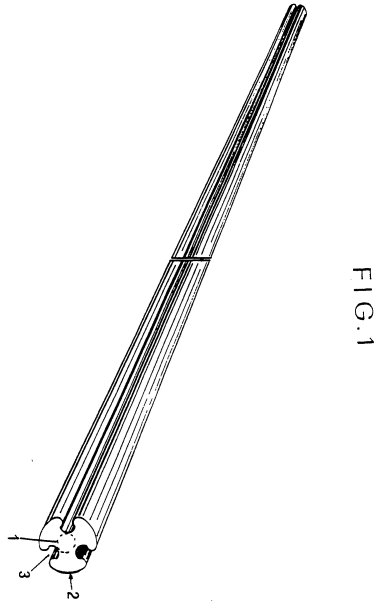
Fig. 1 is a perspective view, on enlarged scale, of an alimentary pasta of the spaghetti type according to the invention; and
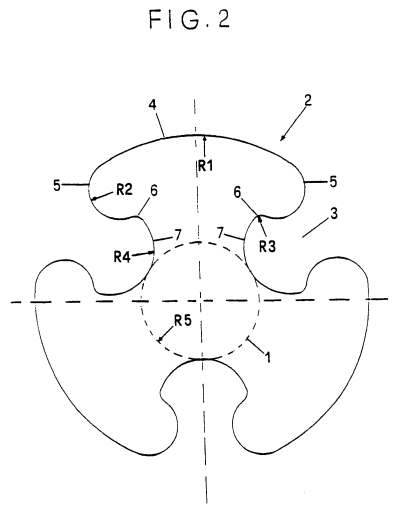
Fig. 2 is a cross-section view, on a still more enlarged scale, of the product according to Fig. 1.
As can be seen from the above figures, the spaghetto according to the invention comprises a solid central core 1, of a substantially circular cross-section, forming a single piece with three parallel longitudinal lobes, generically indicated by numeral 2, said lobes being spaced 120 from each other and separated by grooves 3.
The shape of the lobes 2 and of the corresponding grooves 3 has been the object of intense study, in order to give the product of the invention the advantages described above as compared with the traditional products of the same type and with similar known grooved products.
In particular, each lobe 2 has in cross-section an outline comprising a convex head portion 4 in the form of an arc of a circle, with a radius R1 substantially equal to that of a conventional solid spaghetto of the same diameter, the ends of said head portion being joined to first ends of convex side portions 5, substantially semicircular in shape, having a radius R2 much smaller than R1 (approximately 1/6), the second ends of which are connected by concave portions 6 having a small radius R3 (approximately 1/30 of R2), to the first ends of concave stems 7 in the form of an arc of a circle having a radius R4 greater than R2 (approximately 1.5 times) but less than R1 (approximately 1/4). The second ends of the stems are connected to the second ends of stem portions 7 of adjacent lobes 2.
As stated above, the lobes 2 are separated from each other by grooves 3, each of which, according to the arrangement described above, is defined by the opposite edges of the convex side portions 5, the concave stem portions 7, along with the concave curved portions 6, joining the preceding two, of adjacent lobes 2, from which results a shape wider in the internal area and narrower in the outer, mouth area, thus affording the advantages of preventing tangling of the spaghetti and of closing of the grooves 3 during cooking.
Solely by way of non-limiting example, in a preferred embodiment of the spaghetto according to the invention the measurements of the radii of the parts forming the outline of the cross-section of each lobe 2 are the following:
R1 = 0.765 mm, R2 = 0.135 mm, R3 = 0.045 mm, R4 = 0.207 mm, while the radius R5 of the circular cross-section of the solid central core is 0.270 mm.
It is clearly possible to produce forms with dimensions different from those indicated above, taking care, however, to keep the proportions of shapes and dimensions unchanged.
|
1.
|
Pasta of the "spaghetti" type comprising a solid central core of circular cross-section integral with three parallel longitudinal lobes spaced at angles of 120 from one another and separated by grooves, the cross-section of each of the lobes having an outline with a convex head portion which is in the form of a circular arc with a radius of curvature (R1) substantially equal to that of conventional solid spaghetti of the same diameter and which is joined at its ends to the first ends of substantially semicircular convex lateral portions which have a much smaller radius of curvature (R2) than (R1) and of which the second ends are joined by concave curved portions with a small radius of curvature (R3) to the first ends of respective concave stem portions which are in the form of a circular arc with a radius of curvature (R4) greater than (R2) but smaller than (R1) and which are joined at their second ends to the respective second ends of stem portions of adjacent lobes.
|
|
2.
|
A pasta of the "spaghetti" type as claimed in claim 1, where (R2) is approximately one sixth of (R1), (R3) is approximately one thirtieth of (R2), (R4) is approximately 1.5 times (R2) and approximately one quarter of (R1) and where the radius (R5) of the circular cross-section of said solid central core is approximately twice (R2).
|
|
R. 29(3), (4)
Dependent claim
|
|
3.
|
A pasta of the "spaghetti" type as claimed in claims 1 and 2, where (R1) = 0.765 mm, (R2) = 0.135 mm, (R3) = 0.045 mm, (R4) = 0.207 mm and (R5) = 0.270 mm.
|
|
4.
|
A pasta of the "spaghetti" type as claimed in any of claims 1 to 3, where each of the grooves separating the longitudinal lobes is defined by the opposite outlines of the convex lateral portions, the concave stem portions and the concave curved portions - joining the first two - of the adjacent lobes, resulting in a shape which is wider in the lower part and wider in the outer part of the opening.
|
|
Spaghetti-type pasta provided with a solid central core 1, forming a single piece with three parallel longitudinal lobes 2 which are equidistant angularly, by 120 , relative to one another and separated by grooves 3.
|
R. 33(2), (3), (5)
Content of abstract
|
The balance between the shapes and the sizes of the various elements makes it possible to obtain a rapid cooking time with good chewing qualities.
|

 ANNEX III Examples of European patent applications
 2. Electricity/physics example